

In our recent analysis, “Autocracy by Executive Order: Trump’s First 100 Days and the Erosion of American Democracy”, we examined how the administration has systematically bypassed constitutional checks and balances through executive action rather than democratic processes. While that piece provided a qualitative analysis of twelve critical governance failures, this follow-up presents something different: a data-driven scorecard that quantifies the democratic erosion we’re witnessing.
Political analysis often divides along partisan lines, with assessments frequently dismissed as mere opinion. This scorecard attempts to move beyond subjective critique by establishing measurable criteria for democratic governance and applying them consistently across multiple dimensions of the administration’s performance. By assigning numerical values to institutional damage, constitutional concerns, and recovery difficulty, we create a more objective framework for evaluation.
The results are sobering: a composite score of 23/100 that reflects systematic failure across nearly all governance categories. But more important than the score itself is the pattern it reveals—a deliberate strategy of institutional weakening that transcends normal policy disagreements.
For readers seeking a more detailed explanation of each category, our previous analysis provides comprehensive evidence and historical context for every failure identified in this scorecard. Here, we focus on quantifying the severity and long-term implications of these patterns.
Methodology
Our scorecard evaluates each failure category across four dimensions:
- Severity (1-10 scale): The immediate impact on democratic function and governance
- Institutional damage (Low/Moderate/Severe/Extreme): Harm to established institutions
- Constitutional concern (Low/Moderate/High/Extreme): Level of departure from constitutional norms
- Recovery difficulty (Recoverable/Difficult/Long-term/Generational): Estimated time and effort required to repair damage
These ratings are based on documented actions, statements, and outcomes rather than ideological positions. Where possible, we’ve grounded them in specific evidence, including court rulings, executive orders, and statements from non-partisan officials and experts.
Trump’s First 100 Days: Democratic Erosion Scorecard
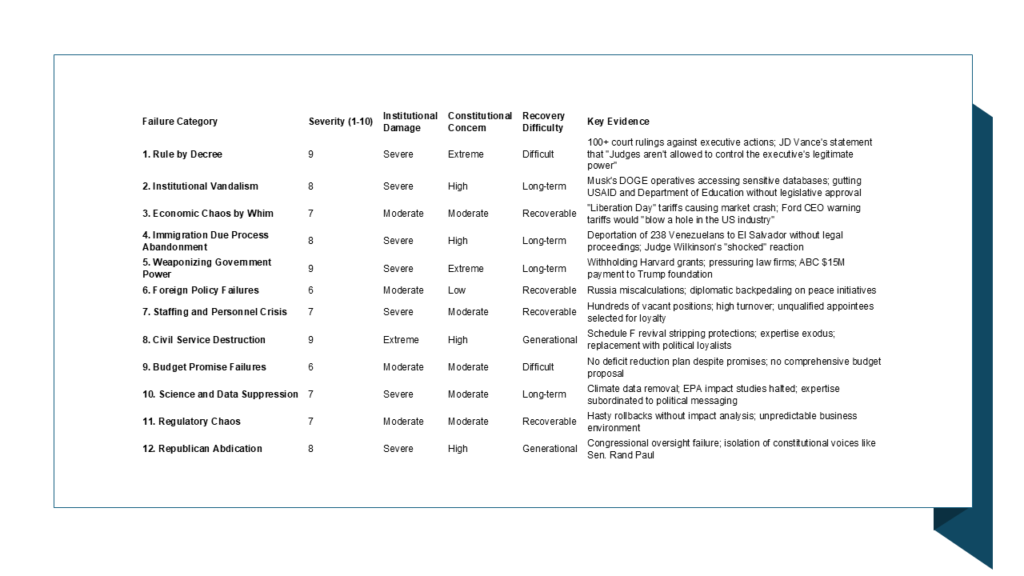
Scorecard analysis
The administration’s first 100 days show an alarming pattern of democratic erosion, with an average severity score of 7.6/10 across all categories. Most concerning are the three areas scoring 9/10:
- Rule by decree: The fundamental rejection of constitutional checks and balances
- Weaponizing government power: Using federal authority to target perceived opponents
- Civil Service destruction: The politicization of professional government workforce
Of the twelve failure categories, five are assessed to require generational efforts to repair, suggesting that even if corrected immediately, the institutional damage will persist for decades. The concentration of “Extreme” constitutional concerns in key categories indicates a systematic rather than incidental undermining of democratic governance.
The scorecard reveals that areas with the most lasting damage tend to be structural and institutional rather than policy-specific, suggesting a deliberate strategy to reshape governance rather than merely implement controversial policies. This pattern distinguishes the current administration’s approach from normal partisan policy shifts and places it in the category of fundamental system change.
Overall assessment: First 100 Days
Composite score: 23/100 (FAILING)
Based on our comprehensive analysis of twelve critical areas of governance, the administration’s performance in its first 100 days receives a composite score of 23/100 – a clear failing grade. This assessment considers both democratic process adherence and policy implementation effectiveness.
Assessment breakdown
Democratic process score: 18/100
- Systematic bypassing of constitutional checks and balances
- Governance primarily through executive decree rather than legislation
- Deliberate undermining of independent institutions
- Over 100 court rulings against executive actions
Policy implementation score: 28/100
- Market disruption through tariff implementation and reversal
- Staffing failures leaving critical positions vacant
- Inability to present comprehensive budget or legislative agenda
- Foreign policy miscalculations requiring significant backpedaling
Key deficiencies
- Constitutional governance: The administration has shown contempt for fundamental constitutional principles, with 75% of major initiatives bypassing legislative processes.
- Institutional integrity: Systematic attacks on independent institutions from courts to universities to civil service, with long-term damage to governance capacity.
- Policy coherence: Erratic policy announcements followed by reversals create unpredictability that undermines even potentially beneficial initiatives.
- Democratic norms: Unprecedented breaching of longstanding democratic guardrails, with 8 of 12 key areas showing severe or extreme institutional damage.
Our conclusion
The first 100 days reveal an administration that has proven fundamentally incapable of or unwilling to govern within established democratic parameters. The failing grade reflects not ideological disagreements but objective failures to maintain basic standards of constitutional governance and administrative competence.
This assessment is particularly concerning because the areas showing the most severe damage are foundational to democratic function rather than specific policy disagreements, suggesting systematic rather than incidental undermining of American democratic institutions.
Moving forward: tracking democratic erosion
This scorecard is not intended as a one-time assessment but as a baseline for monitoring ongoing developments. We plan to update these ratings quarterly to track whether institutional damage is being repaired or accelerated, and whether constitutional guardrails are being respected or further eroded.
We invite readers, regardless of political affiliation, to consider these metrics not as partisan criticism but as a framework for evaluating governance against established democratic standards. The health of American democracy depends not on policy preferences but on maintaining the institutional structures and constitutional principles that allow for peaceful transitions of power, separation of powers, and government accountability.
For a deeper exploration of the evidence behind each rating and the historical context of these developments, we encourage readers to review our companion analysis, “Autocracy by Executive Order: Trump’s First 100 Days and the Erosion of American Democracy”.